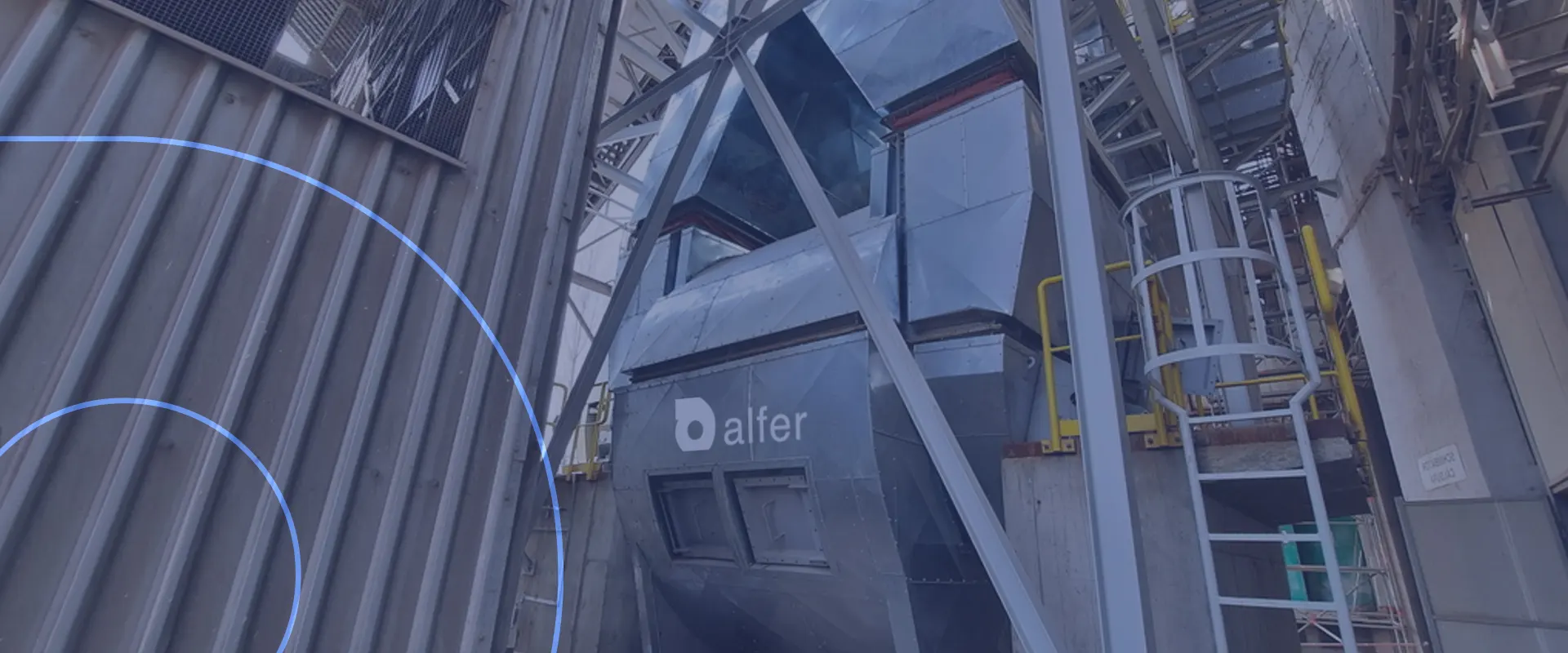
The Sustainability of Production Processes in Heavy Industry Depends Not Only on the Performance of Core Production Equipment but Also on the Efficiency of Auxiliary Systems That Manage Airflow and Process Operations
Especially in the cement, iron and steel, energy, metallurgy, mining, and MDF–particleboard industries, proper industrial fan selection directly affects many critical parameters, from a facility's energy consumption to operational safety.
Harsh process conditions such as high temperatures, heavy dust loads, abrasive particles, and the requirement for continuous operation often make standard fan solutions insufficient. Therefore, industrial fan selection in heavy industry is not merely a technical process based on capacity calculations; it is a strategic engineering decision that influences long-term performance.
In heavy industrial facilities, airflow plays a critical role in ensuring stable process operation. Imbalances in air management can lead to production losses, equipment wear, and increased energy costs. Particularly in high-temperature processes, proper industrial fan selection helps maintain airflow and pressure balance throughout the system.
Well-designed fan systems can provide:
1. Protection of process continuity
2. Improved temperature control
3. Support for emissions management
4. Extended service life of equipment
For this reason, fan systems in heavy industry are not simply auxiliary equipment; they are among the core systems that directly affect process performance.
Proper industrial fan selection should be based on engineering analyses aligned with the actual operating conditions of the facility. Every plant has different requirements in terms of airflow rate, temperature levels, particulate density, and system resistance. Therefore, project-specific evaluations should be preferred over standard solutions.
The airflow and pressure values delivered by the fan system must match the operating range required by the process. Insufficient capacity reduces system performance, while oversized fans can lead to unnecessary energy consumption.
Especially in cement and power plants, incorrect industrial fan selection may result in inefficient system performance and increased operating costs.
In industries with heavy dust generation, fan systems are continuously exposed to abrasive particles. Therefore, industrial fan selection is highly important in terms of material construction and fan geometry.
Alfer Engineering adopts a process-focused engineering approach and develops wear-resistant fan solutions suitable for demanding process conditions.
In processes involving high-temperature gas handling, the thermal resistance of fan systems becomes critical. Particularly in power plants, metallurgy facilities, and cement factories, industrial fan selection directly affects system safety.
Poorly planned systems may lead to vibration, performance losses, and unplanned downtime.
Different fan types are preferred depending on process requirements. Airflow demand, pressure requirements, and the characteristics of the transported gas are the key determining factors.
Radial fans stand out in applications requiring high pressure and handling heavy particulate loads. They are widely used in cement plants and metallurgy facilities.
Axial fans are preferred in applications requiring high-volume airflow. They provide effective solutions especially in mining sites and large-area ventilation systems.
In some heavy industrial processes, standard fan solutions may not be sufficient. Therefore, systems specifically developed according to process requirements are preferred. At this point, proper industrial fan selection becomes a key factor in achieving long-term facility performance.
Alfer Engineering approaches fan solutions for heavy industry not only from an equipment perspective but also through a comprehensive engineering approach that considers the entire process.
Facility operating conditions, airflow requirements, and operational goals are evaluated together to develop customized solutions. This includes optimization of:
1. Radial fan solutions
2. Axial fan systems
3. High-temperature fans
4. Wear-resistant process fans
5. Retrofit and upgrade applications
Thanks to Alfer’s engineering approach, industrial fan selection provides significant advantages in terms of energy efficiency, operational continuity, and extended equipment life.
A significant portion of energy consumption in heavy industrial facilities originates from fan systems. Therefore, proper industrial fan selection plays a major role in reducing operating costs.
Optimized fan systems can deliver more efficient airflow with lower energy consumption. They also help reduce maintenance costs and minimize the risk of unplanned downtime.
For this reason, fan systems should be considered not merely as technical equipment but as strategic investments that influence the long-term sustainability of industrial operations.
Because incorrect fan selection can lead to energy losses, reduced performance, and equipment failures.
Depending on the process, radial fans, axial fans, and custom process fans may be used.
Yes. Properly selected fan systems can improve energy efficiency and reduce operating costs.
Special process fans designed to withstand high temperatures should be preferred.
Alfer Engineering develops customized fan solutions for cement, energy, metallurgy, MDF–particleboard, mining, and many other heavy industry sectors.
For industrial fan selection solutions tailored to your facility, you can contact Alfer Engineering's experts.
We use internet data cookies to improve our service quality. For detailed information, see our Cookie Policy page.
