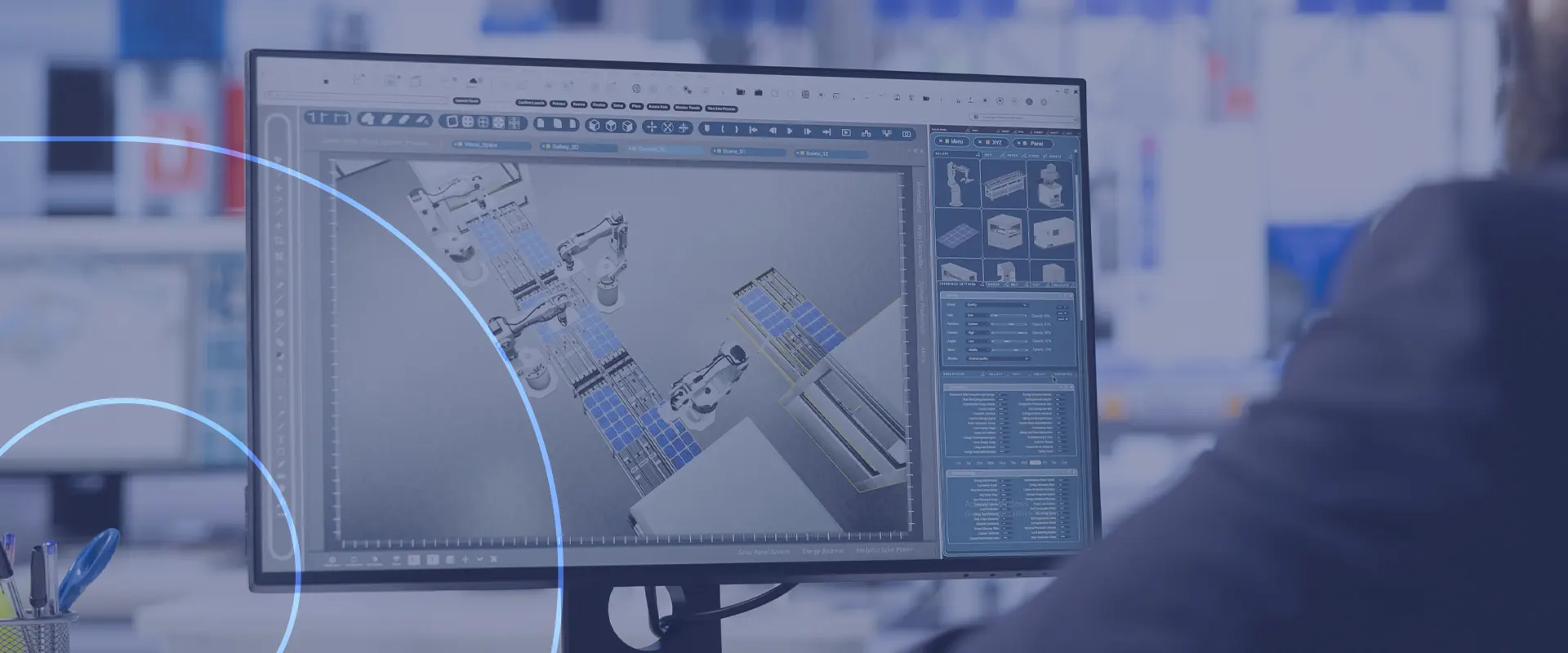
Industrial fans are often perceived simply as equipment that moves air from one point to another. In reality, however, their performance depends on a complex interaction of variables such as airflow patterns, system resistance, operating temperatures, and particle loads. This is why modern industrial fan design relies not only on mechanical calculations but also on advanced engineering tools that allow systems to be optimized before they are even manufactured.
Among these tools, CFD (Computational Fluid Dynamics) has become one of the most valuable technologies in industrial engineering. Particularly in heavy industries, simulating different operating scenarios before installation provides significant long-term advantages in both performance and energy efficiency.
A successful fan system is not defined solely by motor power or airflow capacity. Industrial fans operate within larger ecosystems that include filtration units, ductwork, process equipment, and various operational parameters. For this reason, industrial fan design should be treated as an engineering discipline that directly impacts the entire production line.
In industries such as cement, metallurgy, and power generation, high temperatures and heavy particulate loads can quickly expose the limitations of conventional designs. This is why engineering analysis must begin at the earliest stages of a project.
CFD analysis is an advanced engineering method that digitally simulates air and gas flow behavior before equipment is manufactured. Instead of relying solely on theoretical calculations, engineers can evaluate how a system will behave under real operating conditions.
At first glance, airflow distribution may appear adequate. However, turbulence, pressure losses, and inefficient flow zones often remain hidden until a system is installed. CFD analysis allows engineers to identify several factors before the production stage:
This approach transforms industrial fan design from a trial-and-error process into a predictable and data-driven engineering practice.
A properly executed industrial fan design prevents the unnecessary oversizing of equipment. In many facilities, excessive energy consumption is directly linked to incorrectly selected fan capacities. Well-balanced systems also deliver several operational benefits such as reduced maintenance costs, extended equipment lifespan, fewer unplanned shutdowns, and improved operational continuity.
For this reason, performance optimization should be viewed as a production strategy rather than simply an energy-saving initiative.
Every industry operates under unique conditions. As a result, industrial fan design must always be tailored to sector-specific demands.
High temperatures and abrasive dust require highly durable and wear-resistant solutions.
The controlled transportation of process gases and emission management become primary priorities.
Extreme temperatures and aggressive operating environments demand robust equipment capable of long-term reliability.
Pneumatic conveying systems and intensive particle management play a critical role in maintaining production efficiency.
Alfer Engineering approaches fan systems not as standalone equipment but as integral components of overall plant performance. As highlighted on the company's website, its engineering capabilities are supported by R&D infrastructure, CFD analysis, custom manufacturing expertise, and an ISO 5801-compliant testing facility.
This integrated approach allows engineers to evaluate each project individually, analyze airflow scenarios, incorporate actual operating conditions, and validate performance before implementation. As a result, industrial fan design becomes a long-term performance management process rather than a simple equipment selection exercise.
CFD analysis is an engineering method that digitally simulates air and gas flow behavior using computational models.
Because it directly affects energy efficiency, operational continuity, equipment lifespan, and overall plant performance.
Yes. It helps identify inefficiencies in airflow before installation, allowing systems to be optimized for lower energy consumption.
No. Each industry and facility has unique process requirements that require project-specific engineering solutions.
Yes. Alfer Engineering develops CFD-supported fan design and performance optimization solutions through its engineering expertise and R&D infrastructure.
Contact Alfer Engineering to develop more efficient, reliable, and sustainable industrial fan design solutions tailored to your facility.
We use internet data cookies to improve our service quality. For detailed information, see our Cookie Policy page.
