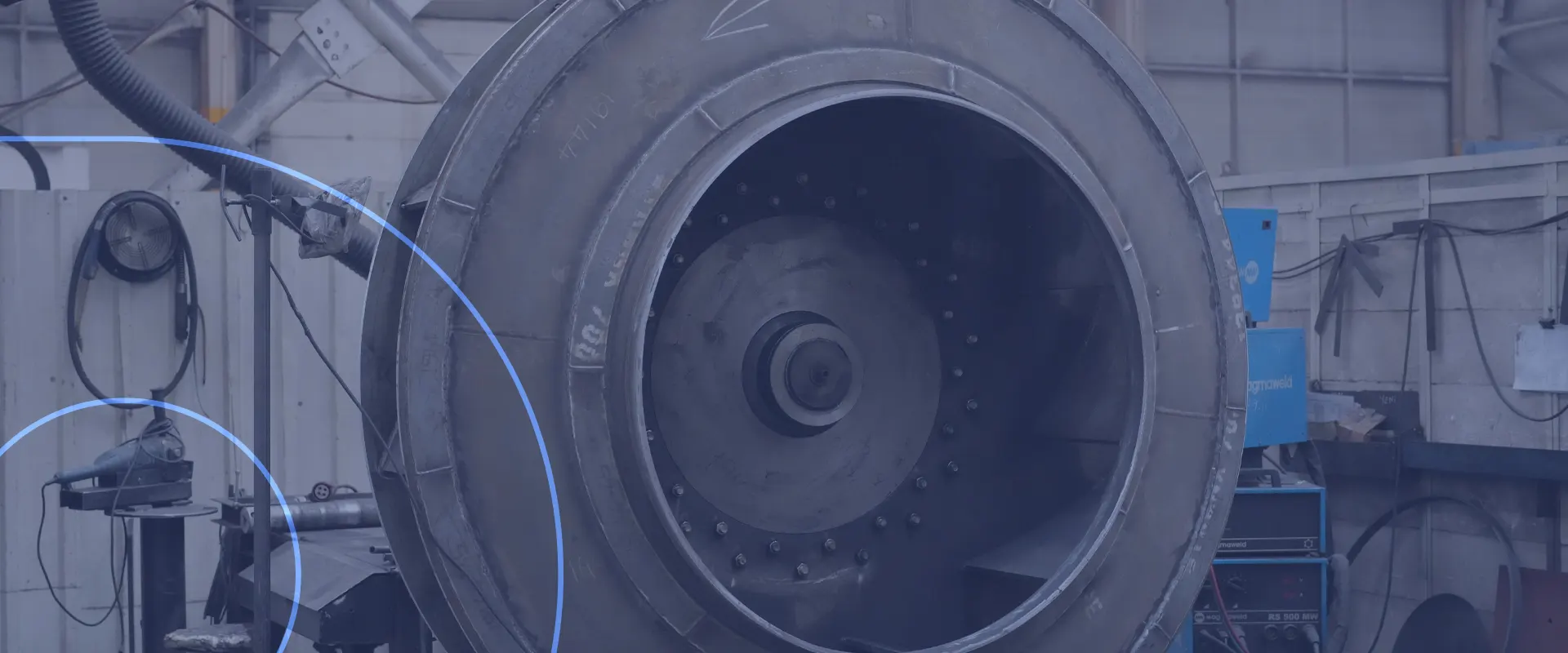
Controlled air and gas flow management is critical for the efficiency of industrial production processes. In systems with high resistance, standard air movement solutions may become insufficient. At this point, high-pressure fans play a vital role by delivering the airflow capacity and pressure levels required under demanding process conditions.
Used across heavy industries such as cement, energy, metallurgy, mining, and MDF–particleboard production, high-pressure fans are preferred not only for air transportation, but also for maintaining process stability, ensuring temperature control, and supporting filtration systems. Especially in processes involving high temperatures and heavy particle loads, selecting the right fan system can directly impact overall plant performance.
High-pressure fans are industrial fan systems designed to transport air or gas under high-pressure conditions. They provide effective performance in demanding operating environments such as long duct lines, high filtration resistance, and elevated temperatures.
Compared to standard fan systems, they are capable of generating significantly higher pressure levels. This makes high-pressure fans essential for maintaining uninterrupted operation in critical heavy industrial processes.
They are particularly important in applications such as filtration systems, pneumatic conveying lines, and process gas management, where maintaining stable airflow is crucial.
The cement industry is one of the most demanding industrial sectors due to high temperatures and intense dust generation. In these facilities, high-pressure fans are used in many critical areas, from raw material mills to clinker cooling systems.
Powerful fan systems are required to balance the pressure resistance created by filtration systems and to ensure controlled transportation of process gases. Especially when integrated with jet-pulse filtration systems, high-pressure fans help maintain stable airflow and support process efficiency.
Improperly designed fan systems may lead to energy losses, unstable airflow, and increased maintenance costs. For this reason, fan selection in cement plants should be evaluated not only in terms of capacity, but also according to overall process conditions.
The transportation of hot gases and flue gas management in power plants require high-performance air handling systems. In this context, high-pressure fans play an important role in boiler systems, flue gas lines, and filtration applications.
Thanks to their high-temperature resistance, these fan systems help stabilize gas flow while supporting the efficient operation of filtration equipment. Particularly in thermal power plants, fan systems can directly affect the facility's overall energy performance.
Alfer Engineering develops project-specific fan solutions for power plants by evaluating process requirements and site conditions together through a comprehensive engineering approach.
The hot gases and heavy particle loads generated during metallurgical processes require highly durable fan systems. Therefore, high-pressure fans are widely used in iron and steel facilities.
In environments exposed to high temperatures and abrasive gases, the thermal resistance and mechanical strength of fan systems become extremely important. Facilities operating under severe conditions require fan systems capable of delivering stable long-term performance.
At this point, Alfer Engineering provides process-specific solutions for heavy industry with abrasion-resistant and high-temperature fan designs.
MDF and particleboard production facilities generate large amounts of wood chips, fine dust, and wood particles. To transport these materials safely through pneumatic conveying systems, strong airflow is required. For this reason, high-pressure fans have become one of the key components of both dust collection systems and pneumatic conveying lines.
Especially in systems with high filtration resistance, improper fan selection may increase energy consumption and disrupt airflow balance. This can directly affect overall process performance.
Alfer Engineering provides process-specific solutions with its high-pressure fans developed for heavy industrial facilities. Fan systems are designed not only as standalone equipment, but also as integrated parts of the facility's overall air management structure.
Within this scope, Alfer optimizes radial fan systems, high-temperature fans, abrasion-resistant process fans, and retrofit and strengthening applications according to process requirements.
Thanks to Alfer's engineering approach, high-pressure fans offer significant advantages in terms of energy efficiency, operational continuity, and long equipment life.
When selecting the right fan system, not only airflow values but all operating conditions of the process should be considered together. Temperature levels, particle density, filtration resistance, duct structure, and energy efficiency goals are among the key factors affecting fan selection.
For this reason, high-pressure fans should not be approached as standard products, but rather evaluated through project-specific engineering analyses.
They are widely used in cement, energy, metallurgy, iron and steel, mining, MDF–particleboard, and chemical industries.
They are preferred because they can provide powerful airflow against high system resistance.
When properly engineered, they can help optimize energy consumption.
Yes. With suitable materials and designs, they can provide reliable high-temperature resistance.
Alfer develops radial fans, high-temperature fans, abrasion-resistant process fans, and retrofit solutions.
Contact Alfer Engineering's expert team to evaluate the most suitable high-pressure fan solutions for your facility.
We use internet data cookies to improve our service quality. For detailed information, see our Cookie Policy page.
