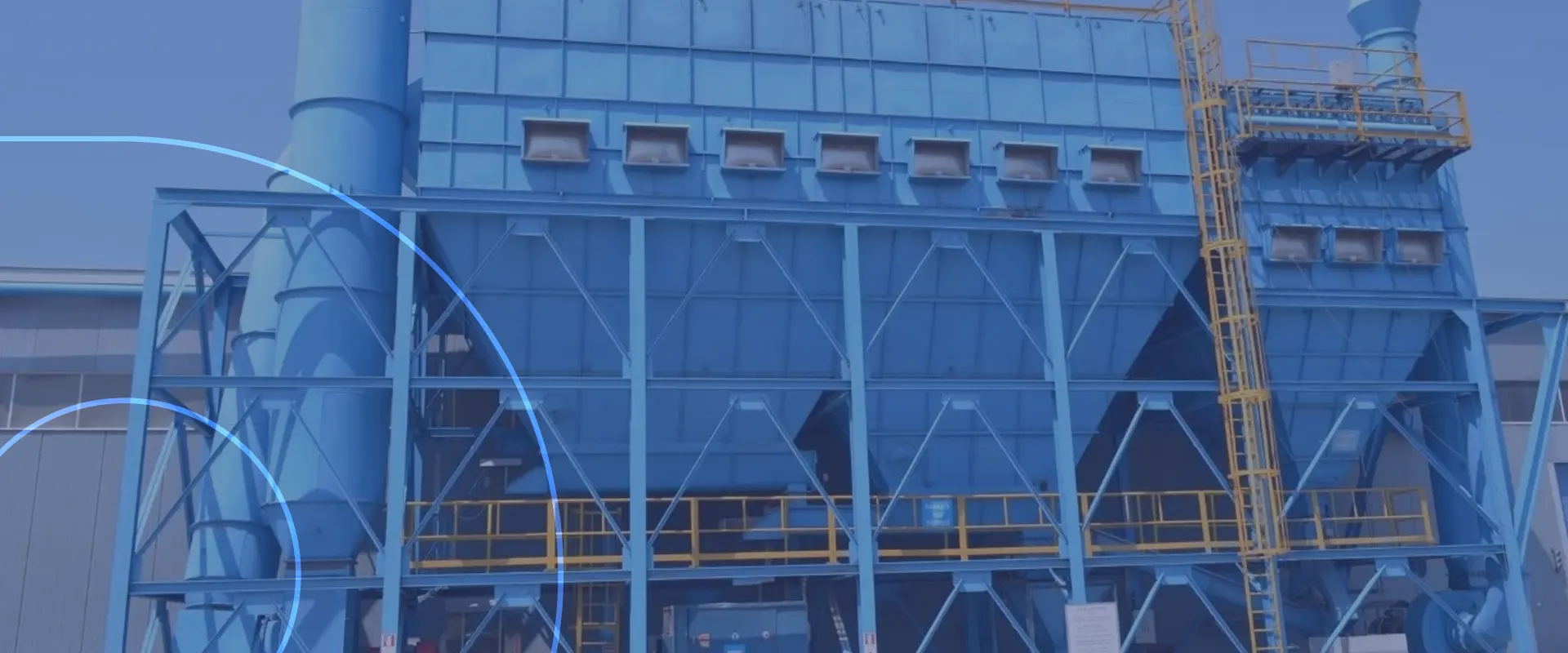
Maintaining air quality in industrial facilities is not only an environmental requirement but also a critical factor for production continuity, workplace safety, and equipment efficiency. In industries with high dust generation such as cement, MDF and particleboard, energy, metallurgy, and mining, filtration solutions directly impact overall plant performance. In this context, cyclone filters and jet-pulse filter systems are among the most widely used technologies in industrial air management.
Although both systems are used for dust control, they differ significantly in terms of operating principles, filtration sensitivity, and application areas. Especially in processes where fine particle control is essential, jet-pulse filter systems stand out as advanced solutions offering high filtration efficiency.
Cyclone filter systems are mechanical separation solutions based on centrifugal force principles. Dust-laden air enters the system at high speed, creating a rotational movement. During this process, larger and heavier particles are pushed toward the outer wall by centrifugal force and fall downward.
Cyclone systems are particularly effective in applications where coarse particle separation is required. Since they contain no moving parts, maintenance requirements are relatively low, and they can operate reliably under harsh process conditions for extended periods.
These systems are generally used as pre-separation units before the main filtration stage. They are widely preferred in MDF and particleboard plants, cement facilities, and pneumatic conveying lines where large chips and heavy dust loads need to be separated at an early stage.
However, cyclone systems alone may not provide sufficient performance when fine particle filtration is required. This is where jet-pulse filter systems become essential.
Jet-pulse filter systems are advanced bag filtration solutions developed to separate fine dust particles from the air with high precision. Filter bags inside the system are automatically cleaned at regular intervals using compressed air pulses. Thanks to this mechanism, the system can operate continuously without interrupting production.
Jet-pulse filter systems are widely used in facilities requiring strict emission control. They provide highly effective filtration performance in industries such as cement, metallurgy, energy, and wood processing.
Compared to conventional filtration solutions, jet-pulse filter systems can achieve significantly higher filtration efficiency. By effectively capturing fine particles, they improve indoor air quality while supporting environmental emission control.
Key advantages of these systems include continuous operation without production shutdown, the ability to achieve low emission values, high filtration efficiency for fine particles, and easier maintenance through automatic cleaning mechanisms.
Alfer Engineering develops jet-pulse filter systems tailored to the process requirements of different industries, helping facilities achieve more efficient and sustainable air management.
The primary difference between cyclone systems and jet-pulse filter systems lies in filtration sensitivity. Cyclone filters are effective at separating coarse particles, whereas jet-pulse filter systems are designed to capture much finer dust particles with high efficiency.
There are also important differences in terms of application purpose. Cyclone systems are generally positioned as pre-separators, while jet-pulse filter systems serve as the final filtration solution.
In addition, jet-pulse filter systems can achieve much lower emission levels, making them more suitable for compliance with environmental regulations. For this reason, modern industrial facilities often use cyclone systems and jet-pulse filter systems together in an integrated configuration.
Alfer Engineering approaches filtration solutions not only from an equipment perspective but also through a comprehensive engineering approach that considers the entire process. Dust characteristics, airflow requirements, process temperatures, and operational conditions are evaluated together to develop project-specific solutions.
Within this scope, jet-pulse filter systems, cyclone filtration solutions, dust collection systems, and fan and filtration integrations are optimized together to achieve high-performance air management.
Thanks to Alfer’s engineering expertise, jet-pulse filter systems provide significant advantages in terms of energy efficiency, operational continuity, and reduced maintenance requirements.
Jet-pulse filter systems are widely used in industries where heavy dust generation occurs. They are particularly preferred in cement plants, MDF and particleboard production facilities, power plants, metallurgical facilities, and mining operations as high-performance filtration solutions.
In processes where fine particle control is critical, jet-pulse filter systems play an important role in maintaining air quality and keeping emissions under control.
Cyclone filters mechanically separate coarse particles, while jet-pulse filter systems capture fine dust particles with high precision.
They are preferred because of their high filtration efficiency, low emission values, and ability to operate continuously.
They can be effective for coarse particle separation, but applications requiring fine dust control generally require integration with jet-pulse filter systems.
Yes. Properly engineered systems can optimize airflow and help reduce energy consumption.
Alfer Engineering provides filtration and fan solutions for cement, energy, MDF and particleboard, metallurgy, mining, and many other heavy industries.
To evaluate the most suitable jet-pulse filter systems for your facility, you can contact Alfer Engineering's expert team.
We use internet data cookies to improve our service quality. For detailed information, see our Cookie Policy page.
